Divided by Design: Closing the Professional Divide Between Planners and Engineers Before It Derails Your Next Project

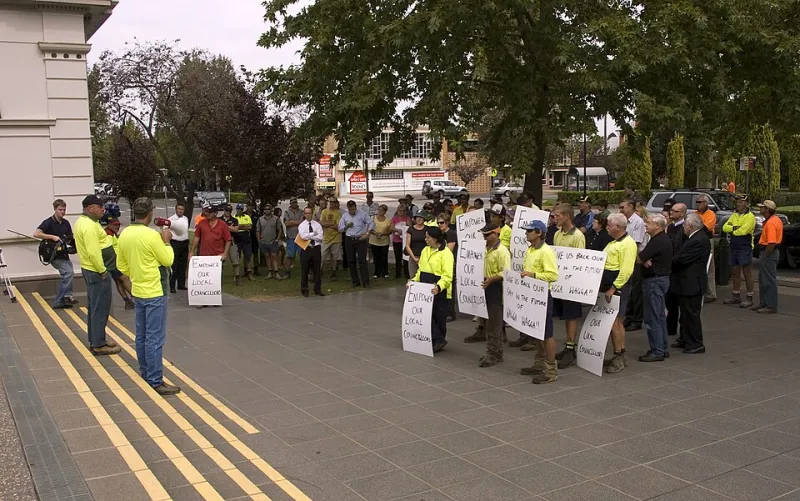
Photo: Glensburg Town Planners, CC BY-SA 4.0, via Wikimedia Commons
Somewhere between a planning department's vision for a complete street and an engineering team's construction documents for that same corridor, something frequently gets lost. The bike lanes narrow. The street trees disappear to accommodate utility clearances. The pedestrian refuge islands vanish from the final design because turning radius calculations left no room. The planner who championed the project for three years barely recognizes the built result.
This is not a story about bad actors. It is a story about professional distance—the accumulated effect of separate graduate programs, divergent regulatory frameworks, misaligned performance metrics, and decades of siloed municipal workflows. In cities across the United States, planners and engineers are nominally partners in shaping the built environment, yet they frequently operate as parallel functions that intersect only at the most transactional moments. The result is implementation friction that erodes design intent, strains interdepartmental relationships, and ultimately undermines the public trust that both professions depend upon.
Two Professions, Two Definitions of Success
To understand why planners and engineers so often struggle to communicate effectively, it helps to examine what each discipline is trained to optimize. Planning education emphasizes systems thinking, policy analysis, community engagement, and long-range vision. Planners are taught to hold complexity, balance competing interests, and work in conditions of uncertainty. Engineering education, by contrast, emphasizes precision, quantifiable performance standards, liability management, and technical compliance. Engineers are trained to reduce ambiguity, not inhabit it.
Neither orientation is wrong. Both are necessary. But when a planner describes a street as a "place for people" and an engineer reads a set of geometric design standards that define acceptable lane widths, sight distances, and load-bearing requirements, they are working from fundamentally different ontologies of what a street is and what it is supposed to do.
The language gap compounds this. Planning documents speak in terms of goals, principles, and policy frameworks. Engineering documents speak in terms of standards, specifications, and measurable tolerances. When a comprehensive plan calls for streets that "prioritize pedestrian comfort and safety," that language carries genuine meaning within a planning context. Inside an engineering workflow governed by AASHTO guidelines and state DOT standards, however, that same phrase has no operational definition. It cannot be drawn. It cannot be bid. It cannot be inspected.
Where the Breakdown Becomes Visible
The most visible manifestations of this divide tend to surface during project handoffs—the moments when a planning concept transitions into engineering design, or when an engineered solution requires a zoning or land use determination. These handoff points are where assumptions collide with constraints, and where the absence of shared language becomes a project risk.
In many municipalities, planning and engineering departments have separate chains of command, separate budget cycles, and separate relationships with elected officials. They may share a project management system but rarely share a working vocabulary or a common understanding of project priorities. A traffic engineer asked to review a proposed road diet may evaluate it primarily through the lens of level-of-service metrics. A planner who designed that road diet may have been optimizing for pedestrian crossing safety, economic vitality of adjacent storefronts, and consistency with an adopted corridor plan. Both professionals are doing their jobs. Neither may fully appreciate what the other is trying to protect.
The consequences extend well beyond aesthetic disappointment. Projects delayed by interdepartmental disagreements cost money. Designs that require multiple revision cycles consume staff capacity that smaller municipalities can rarely afford. And when built outcomes diverge significantly from adopted plans, the credibility of the planning process itself is damaged—making future community engagement harder to sustain.
Cities That Are Doing It Differently
A handful of American cities have begun treating the planner-engineer relationship as a deliberate organizational design problem rather than an inevitable feature of municipal bureaucracy.
Some have restructured their project delivery workflows to create mandatory joint review periods early in the design process—before engineering constraints become locked in and before planning intent becomes too abstract to operationalize. By requiring planners and engineers to sit together during conceptual design phases, these cities are forcing translation to happen when it is still relatively cheap, rather than during construction document review when changes carry significant cost penalties.
Others have invested in cross-disciplinary training programs that give planners basic fluency in engineering standards and give engineers exposure to planning policy frameworks and community engagement methodology. These are not full professional crossovers—no one is asking planners to calculate storm drain capacity or asking engineers to facilitate public workshops. The goal is sufficient mutual literacy to ask better questions of one another and to recognize when a professional assumption is actually a design choice that deserves discussion.
Several mid-size cities have experimented with embedded staffing models, placing a planner within the public works or engineering department on a rotating basis, and vice versa. These assignments function less as technical training and more as relationship infrastructure—creating personal connections and shared context that make future collaboration measurably smoother.
Building a Shared Framework
For planning directors and city engineers interested in improving their working relationship, the literature and practitioner experience point toward a few consistent principles.
First, shared glossaries matter more than they might appear to. Taking the time to define key terms across disciplinary contexts—what "safety" means to a traffic engineer versus a pedestrian advocate versus a planner, for instance—surfaces assumptions before they become disputes.
Second, early and structured collaboration is more effective than late-stage review. The further a project advances before the two disciplines engage substantively, the more entrenched each team's assumptions become and the more costly reconciliation grows.
Third, organizational culture shapes outcomes as much as process design. Cities where planning directors and city engineers have strong working relationships—where they meet regularly, understand each other's pressures, and speak candidly about constraints—consistently report smoother project delivery than cities where the two functions interact primarily through formal document review channels.
Finally, leadership visibility matters. When city managers and mayors signal that cross-departmental collaboration is a genuine organizational priority rather than a procedural checkbox, both planning and engineering staff tend to invest more in making it work.
The Deeper Stakes
The planner-engineer communication gap is, at its core, a question about what kind of cities American communities want to build—and whether the professionals charged with building them can align well enough to deliver on that promise. Both disciplines are indispensable. Neither can substitute for the other. But the persistent friction between them represents an enormous amount of wasted institutional energy, eroded design intent, and deferred public value.
Closing that gap will not happen through goodwill alone. It requires deliberate investment in shared language, structured collaboration, and organizational cultures that reward professional translation as a core competency. For planning networks and professional associations, there is a meaningful role to play in building the cross-disciplinary infrastructure that individual municipalities cannot easily create on their own—convening joint forums, developing shared training curricula, and elevating the practitioners who have already figured out how to make these partnerships work.
The cities that get this right will not just deliver better projects. They will build the kind of interdepartmental trust that makes ambitious planning possible in the first place.